中文简体
中文简体 English
 Español
Content
- 1 Why the Cable Type Matters More Than the Jacket Color
- 2 The Three Standard Power-Limited Fire Alarm Cable Types
- 3 Armored and Fire-Rated Cables for Circuit Survivability
- 4 Where Coaxial and Fiber Cables Fit in a Fire Alarm System
- 5 How to Choose the Right Fire Alarm Cable Type
- 6 Standards That Define Fire Alarm Cable Types
Specifying a fire alarm system for a 14-story office tower starts with a simple question that must be answered before any cable is ordered: which fire alarm cable type belongs in the plenum, and which one can be pulled through the riser? The answer determines code compliance, how much power the circuit can deliver, and how the system behaves when smoke and heat are already working against it. This guide covers the standard fire alarm cable types, the survivability cables used on critical circuits, and the coaxial and fiber transmission lines that support modern life-safety networks.
Why the Cable Type Matters More Than the Jacket Color
The red jacket is the most visible feature of a fire alarm cable, but it tells you very little. The markings on the jacket do. FPL, FPLR, and FPLP are not brand names or color choices; they are classifications defined by the National Electrical Code (NEC) that specify where a cable may be installed, how the insulation is constructed, and how the cable behaves under flame exposure.
Those classifications exist because fire alarm circuits protect lives. A cable that spreads flame along a riser can carry fire from one floor to the next. A cable with poor smoke resistance can fill an air-handling space with combustion products before the alarm has even been verified. Selecting the wrong type is not a performance concern; it is a code violation with direct safety consequences.
The Three Standard Power-Limited Fire Alarm Cable Types
Fire alarm circuits divide into two categories that drive cable selection: power-limited and non-power-limited. Power-limited circuits operate at lower voltage and current and cover most modern addressable systems. Under NEC Article 760, the three standard power-limited fire alarm cable types are FPL, FPLR, and FPLP.
FPL: General-Purpose Fire Power Limited Cable
FPL is the baseline cable for ordinary, dry indoor locations. It is commonly used in concealed runs behind walls, inside conduit, or in spaces with modest fire performance requirements. It is the most economical option and is suitable for initiating device circuits and notification circuits in low-hazard buildings.
FPLR: Riser-Rated Fire Power Limited Cable
FPLR is designed for vertical riser shafts that pass from floor to floor. The insulation and jacket are formulated to resist flame spread, so a fire on a lower floor cannot travel upward through the cable. Building codes generally require riser-rated cable for vertical runs unless the conductors are enclosed in metal conduit.
FPLP: Plenum-Rated Fire Power Limited Cable
FPLP is the highest-performing standard type. Plenums are spaces used for air circulation, typically the area above a suspended ceiling or below a raised floor. A plenum-rated cable must limit both flame spread and smoke generation because burning material can release dangerous gases directly into the air supply. FPLP can be substituted for FPL or FPLR in nearly every installation; the reverse substitution is not permitted.
| Cable type | Primary location | Flame performance | Typical use |
|---|---|---|---|
| FPL | Ordinary dry locations | Basic flame resistance | Concealed interior runs |
| FPLR | Vertical riser shafts | Flame-spread resistant | Runs between floors |
| FPLP | Plenum air spaces | Low smoke and flame spread | Above ceilings, below raised floors |
Armored and Fire-Rated Cables for Circuit Survivability
Standard FPL-family cables are fire-retardant: they resist burning but do not guarantee that the circuit keeps operating during a fire. NFPA 72, the national fire alarm and signaling code, requires a survivability level for certain pathways, including stairwell pressurization fans, smoke management systems, and the notification appliances that direct occupants to exits. In those applications the circuit must remain operational for two hours of fire exposure.
Metal-Clad (MC) Cable
MC cable protects conductors with a continuous aluminum or steel armor. It handles exposed runs where physical damage is possible and contains flame within the metal sheath. That mechanical protection is valuable, but MC cable alone does not carry a two-hour fire-resistive rating.
Mineral-Insulated (MI) Cable
MI cable uses copper conductors inside a copper sheath with compressed magnesium oxide as insulation. It is genuinely fire-resistive: it continues to operate under direct flame exposure and is capable of meeting the two-hour survivability requirement in NFPA 72.
PH120 Fire-Rated Circuits
PH120 cables are engineered to survive at least 120 minutes of fire exposure, combining fire-resistive insulation with circuit-integrity construction. They are the cables most often specified for NFPA 72 survivability pathways and are significantly more expensive than standard FPLP, so they should be limited to the circuits that genuinely require them.
Where Coaxial and Fiber Cables Fit in a Fire Alarm System
Cable discussions tend to focus on detectors and horns, but a real installation also includes alarm verification video, networked panels, and links to building management systems. Those transmission paths are typically coaxial or fiber optic, and their performance is just as critical as the alarm loop itself.
Coaxial Cable for Alarm Verification and Video Monitoring
Video cameras are a practical extension of a fire alarm system. Operators use live pictures to confirm an alarm, assess the fire condition, and guide evacuation. The transmission path for those cameras is commonly 75-ohm coaxial cable. An RG6 braided coaxial cable matches the 75-ohm impedance standard used by CCTV and video equipment and carries clear signals over distances that wireless links cannot reliably cover.
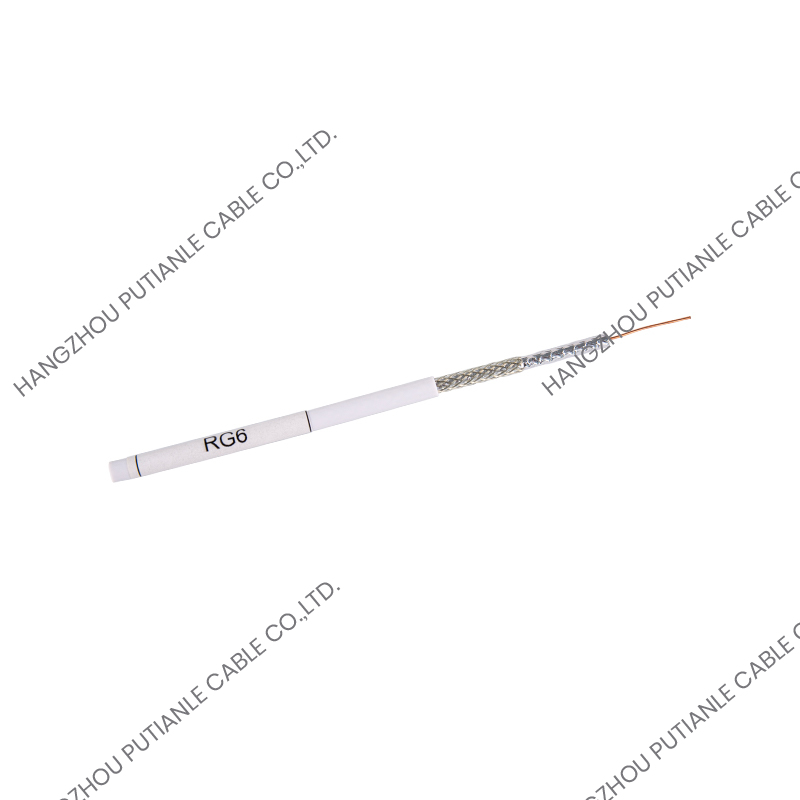 RG6 Simple Installation Outer Conductor 75 OHM Braiding Cable Manufacturers, CusHangzhou Putianle Cable Co., Ltd. is China Custom RG6 Simple Installation Outer Conductor 75 OHM Braiding Cable Manufacturers,Company,Int...View Product →
When camera runs become long, attenuation becomes the limiting factor. A 75-ohm aluminum tube cable such as the QR860 aluminum tube cable delivers lower signal loss per meter, which keeps video usable on perimeter and parking-area surveillance feeds that support fire monitoring.
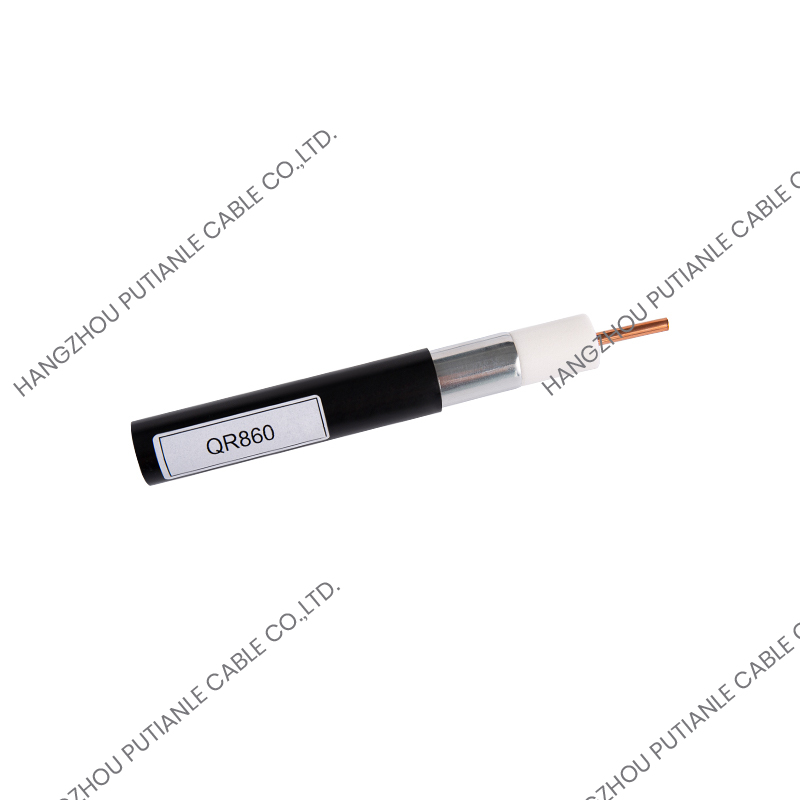 QR860 High Flexibility 75 OHM Aluminum Tube Cable Manufacturers, Custom CompanyHangzhou Putianle Cable Co., Ltd. is China Custom QR860 High Flexibility 75 OHM Aluminum Tube Cable Manufacturers,Company,Meet the QR860 ...View Product →
Fiber Optic Connections for Networked Life-Safety Systems
Large campuses and high-rise buildings connect distributed panels over fiber-optic links. Fiber carries data without electromagnetic interference, spans distances far beyond copper, and adds no conductive path between buildings. For indoor monitoring and panel interconnects, a GJXFH fiber optic cable offers a lightweight, bend-tolerant solution that fits neatly into the same cable trays as other life-safety circuits.
 GJXFH-FIBER Reinforced Armor Layer Optical Cable Manufacturers, Custom CompanyHangzhou Putianle Cable Co., Ltd. is China Custom GJXFH-FIBER Reinforced Armor Layer Optical Cable Manufacturers,Company,Unveil the GJXFH...View Product →
How to Choose the Right Fire Alarm Cable Type
Conductor and Gauge
Solid copper is the most common conductor for initiating device circuits because it holds its shape under termination screws and resists corrosion. Stranded conductors suit notification appliance circuits that experience repeated flexing. Gauge selection must account for voltage drop: the circuit must deliver adequate voltage to the farthest notification appliance, and a frequently applied design target is 85 percent of rated voltage at the end of the run.
Shielding
Shielded FPL, FPLR, and FPLP are specified when alarm circuits run near power cables, variable-frequency drives, or other sources of electromagnetic interference. The shield blocks noise that could cause false alarms or suppress incoming signals. It should be grounded at one end only to avoid ground loops.
Environment and Installation
Damp locations require moisture-resistant jackets, and hazardous areas call for additional listings. The installation itself is part of code compliance: cables must be supported at regular intervals and secured so they cannot collapse into doorways or evacuation routes during a fire.
A Practical Decision Sequence
Start with the location. Ordinary dry interior space means FPL; a vertical riser means FPLR; an air-handling plenum means FPLP. Add shielding where interference is present, then confirm voltage drop on the longest run. If the circuit must survive a fire, move up to MC, MI, or PH120 cable and budget accordingly.
Standards That Define Fire Alarm Cable Types
- NEC Article 760 establishes the power-limited and non-power-limited circuit categories and names the permitted cable types.
- NFPA 72 is the national fire alarm and signaling code; it defines installation rules and requires two-hour survivability for specific pathways.
- UL 1424 covers power-limited fire alarm cables and is the standard behind the FPL family of markings.
- IEC flammability rating is the international counterpart and is commonly referenced in projects outside North America.
Regional practice matters. A cable that meets UL requirements may not satisfy the equivalent IEC flammability rating, so the governing standard of the project jurisdiction should be confirmed before procurement. Understanding how coaxial cable construction types differ in impedance, shielding, and fire performance also helps when planning the transmission portion of a security and life-safety system.
The cable type follows the code path: plenum, riser, or general-use; power-limited or not; survivability required or not. Once those decisions are made, the correct FPL family, MC, MI, or PH120 cable is clear. The transmission side deserves the same attention. Video verification and networked monitoring depend on well-selected coaxial and fiber links, so matching the cable to the distance, environment, and signal format is the last step in building a life-safety network that works when it is needed.